Water Extraction & Removal in New Port Richey, FL
Standing water does the most damage in the first day, while it wicks into baseboards, drywall and cabinet bases. The extraction crew pulls it out first, so the drying can start on a floor that is no longer holding water.
(888) 621-2041Get emergency water extraction started in New Port Richey- 24/7 dispatch
- IICRC S500 drying goal
- Daily moisture readings
What to do first about water extraction
Do only what feels safe. Water near an outlet, a sewage smell or a sagging ceiling means stepping back and calling first.
- 1
Stop the source
Close the main valve or the fixture shutoff so no new water enters.
- 2
Kill wet circuits
Switch off breakers for wet rooms only if the panel sits somewhere dry.
- 3
Move what you can
Lift rugs, electronics and furniture off the wet floor or onto blocks.
- 4
Photograph first
Take wide and close photos of every wet room before anything is thrown out.
What does water extraction cost in New Port Richey, FL?
In New Port Richey, FL, water extraction typically runs $900 to $4,500, with drying billed on top, depending on the wet area, the water category and how much water is standing.
These are ranges seen on west Pasco jobs, not a price for your home. The water damage cost calculator narrows it; the moisture map on the walkthrough decides it.
How water extraction is handled in New Port Richey
Source first
The response team confirms the water is off before any extraction starts.
Map, then pull
Moisture mapping shows how far the water traveled under tile and behind trim.
Truck-mounted power
The extraction crew runs truck-mounted units that send water out of the house, not into the next room.
Straight into drying
Air movers and LGR dehumidifiers go down as soon as the floors stop holding water.
The four stops of a water extraction dry-out
- 1
Trace and measure
A thermal camera and a pinless meter show the restoration team how far the water spread before a single fan is placed.
- 2
Pull the water out
Truck-mounted extraction empties the floors and the carpet pad first, because every gallon left behind adds drying days.
- 3
Move the air, pull the humidity
Air movers push moisture out of walls and floors, and LGR dehumidifiers take it out of the damp coastal air.
- 4
Read it dry, then log it
Daily meter readings are compared with an unaffected room; the drying stops when the numbers are within 2 to 4 points.
Most New Port Richey homes sit on a concrete slab, and many have tile, laminate or luxury vinyl over it. Water on those floors does not soak in the way it does over a wood subfloor, so it spreads. Within hours it finds the edges of the room, climbs into baseboards and the bottom of drywall, and runs under cabinets and closet doors. Extraction is the step that stops that spread.
What water extraction involves in a New Port Richey home
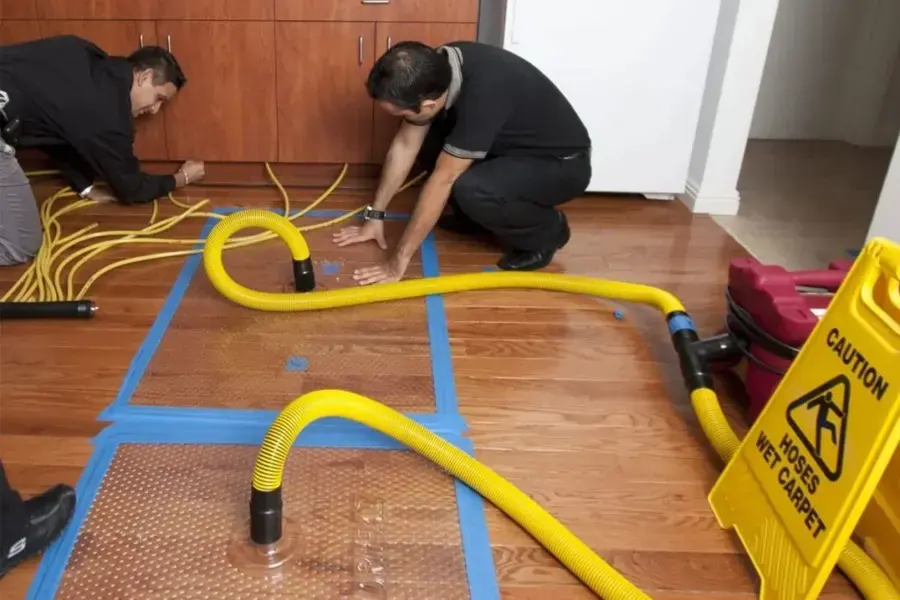
The extraction crew starts at the lowest point of the wet area and works back toward the source. On hard floors a squeegee wand and a truck-mounted unit move the water out of the house through a hose. On carpet, weighted extraction tools press water out of the pad, and the tech who does the walkthrough decides whether the pad can be saved or has to be pulled. Manufactured homes get a check underneath too, because water that runs through the floor collects in the belly.
- Truck-mounted extraction for large volumes and long hose runs
- Portable extractors for condos, villas and tight hallways
- Floor drying mats for wood and laminate that trapped water between boards
- Pinless meters and thermal imaging to find water that does not show
Why extraction comes before drying equipment
Air movers and dehumidifiers are built to pull moisture out of materials, not to remove standing water. Every gallon left on the floor has to be evaporated into the air and then pulled back out by a dehumidifier, which adds days to the job. That is why most crews extract twice: once on arrival, and again after furniture is moved and hidden water under cabinets and carpet edges comes out. The structural drying page covers what happens next.
Clean water does not stay clean
Water from a supply line starts as Category 1, but after a day or two on a warm floor it can turn into Category 2. That shift changes what can be saved, so the drying clock matters.
Water that needs more than extraction
Storm surge, river water and sewage are Category 3. The mitigation team extracts them in protective gear, removes porous materials they touched, and cleans and treats the structure before drying. The EPA mold cleanup guidance explains why wet materials need to be dried or removed quickly, and Ready.gov covers flood safety before anyone walks into the water. For surge or sewage, see storm surge flood cleanup and sewage and septic backup cleanup.
Where water extraction calls come from
The restoration team covers New Port Richey itself plus the 34652, 34653, 34654, 34655 and 34656 ZIP areas: downtown and Gulf Harbors, Elfers, Moon Lake, Trinity and Seven Springs, with Port Richey, Holiday and Hudson next door.
Every town, ZIP and neighborhood coveredRelated water damage services in New Port Richey
Water Extraction & Removal questions, answered
Answers based on how these losses usually go in west Pasco homes; your own walkthrough settles the details.
Ask the New Port Richey team about water extractionHow much water can a truck-mounted extractor remove?
A truck-mounted unit moves far more water per pass than a household wet vac, and it sends the water out through a hose instead of into a tank that has to be emptied. That is why it is the first tool on most larger losses.
Can wet carpet be saved after extraction?
Often, if it was clean water and the carpet is extracted and dried quickly. The pad under it usually comes out because it holds water and is inexpensive to replace. Carpet touched by sewage or floodwater is removed.
Is a shop vac enough for a small leak?
For a small puddle of clean water on tile, sometimes. The problem is the water you cannot see under baseboards and cabinets, which a moisture meter finds and a shop vac does not.
How long does extraction take?
Most single-room extractions are finished the same visit, and larger losses take a few hours before drying equipment goes down. The drying itself usually takes several days.
Do I need to move furniture first?
Move small items, rugs and electronics if it is safe. The extraction crew can move heavy furniture and set it on blocks or foil so the legs do not stain the floor.
What happens to water under the tile?
Tile over a slab often stays in place while the drying team dries through the grout and the edges. Moisture readings decide whether any flooring has to come up.
Water Extraction & Removal in New Port Richey? Call now.
Wet drywall, cabinets and subfloor do not dry on their own in Pasco humidity. A call now puts extraction and drying on the schedule today.
(888) 621-2041Pull the water out of the New Port Richey house now